Friday, October 29, 2010

Will We Ever Reach Peace in the OB v. NCB war?

I'm considering removing my RSS subscription to MyOBsaidWhat?!? I used to read all the comments and sometimes comment myself, but lately I've realized that it is steeped in negativity, and I'd rather focus on the positive. Reading there, it becomes easy to assume that all doctors are unhuman douchebag stabby-hands. Of course, the "Thoughtful Thursdays" are wonderful examples of what to say to a woman, but because they are featured once a week, they come across as the rare exception in a world of horribleness. If any doctors show up and make efforts to defend their profession, they are almost always met with hostility by people who know nothing about how they practice medicine or treat their own patients.

I was recently surfing a blog called OB/Gyn Kenobi, because I thought the name was really clever, written by an anonymous obstetrician who calls herself Dr. Whoo? I haven't read a lot on her blog, but I can tell that she believes in individualized patient care and recognizes that the issue of liability in the American legal system is a huge problem for her profession. I came across one post where she expressed a lot of frustration about how the natural birth community views obstetricians, automatically assuming that they are all the same horrible stereotype. She points out that in her current practice, there is a split in philosophy between the older generation and her own younger generation.

My personal experiences corroborate her observations, as the OB I saw during my first pregnancy before switching to a midwife group, was an older doctor, and he had a "my way or the high way" attitude, complete with continuous EFM, mandatory IV infusion, NPO, and pushing on your back only. He believed that episiotomy is necessary for about a third to half of all women and that all women change their minds about wanting a natural birth when they are in labor. The OB/Gyn I saw in my second pregnancy was younger and was nothing like this--she was supportive of low-intervention birth if all was going well, and had attended many unmediated labors. She almost never did episiotomies, and actually encouraged me to write a birth plan.

It is wrong to define obstetrics by extreme negative examples. There are great OB/Gyns out there. I'd like to hope that there are a lot of them.

One of Dr. Whoo?'s most compelling points is this:
Perhaps the most disheartening thing, is that there can be no real dialogue between the two philosophies, so jaded are our particular perspectives.
I appreciate that she acknowledges that the obstetric side has a jaded perspective, too. This is evidenced by some of the comments on the post:
The fan page looks good so far. You might want to include links to things like: Mothers in Medicine, pages where people can get real information about Ob/Gyn services (other than the doctor hating, "busness of being born" websites)
Condescending, much? Here is another
go to alldoula.com I went there trying to figure out what a doula was. They are very anti-OB and also are giving very bad advice to pregnant women.
That almost makes me ashamed to call myself a doula. And this one
Do any of these doctor bashing twits realize that just a few generations ago women DIED from "natural" at-home childbirth (the only kind going, back then) on a regular basis?
I would be remiss if I didn't address the fallacy of the "women used to die and now they don't" argument. You can not compare statistics from different time periods and assume that one change in that time is the determining factor in the change in statistics. Natural birth advocates know that hosptials and interventions have benefits and save lives in certain situations. That is why women who plan to birth at home have a plan for transfer to the hospital if complications arise. The burden of reaching out the olive branch of peace is really on us because we need obstetricians. Modern homebirth, though significantly safer than homebirth in antiquity (due to sanitation and better midwifery knowledge and emergency medications that can be given in the home), can never really be safe without hospital back up. All too often, women who transfer to the hospital from a planned homebirth are met with hostility for choosing not to use the hospital and then needing it after all. The truth is she needed you all along, just in a different way than you wanted her to need you.

We need to focus on what we have in common--a desire to improve birth for everyone. We may have different opinions about how that can be done, but we will never get anywhere if we keep making this a war. Division is hurting us, and hurting mothers and babies. We cannot afford to alienate all of the the obstetricians our there who care deeply about mothers and babies and make birth their life's work! Just as there are various types of natural birth advocates, each obstetrician is an individual person. Many of these people are caring and sensitive and we push them away with our belief in an extreme stereotype. It is bigotry, and I am done with it. I am committing now to make my blog a doctor-friendly zone. I want better care for pregnant women and their babies and that is only going to come about with peace and collaboration.

Tuesday, October 26, 2010

check out Candy Clips by B for cute and simple hair accessories

As you may have noticed, I always like to support my friends and family in their online business ventures. My cousin's wife (who's name actually became my maiden name when she married him, just spelled differently) just started an etsy shop called Candy Clips by B. Her clips are really cute, and they are mostly in solid colors that will go with all different outfits. Most of them can be worn by any age--her photos show the same sizes of clips being worn by her and her two year old daughter. She is having a giveaway on her blog to promote her shop.

Saturday, October 23, 2010

Elective Cesareans as Commentary on a Failed Birth Model

A recent article out of Australia, Fear of natural birth driving one in three mothers to cesarean, addresses the issue of maternal request cesareans. I feel that this article misrepresents the issue by placing so much of the burden of rising cesarean rates on maternal request. The author doesn't site a source for the "research" that supposedly supports this, but research can be misleading in what they categorize as "elective cesareans." Sometimes such cesareans are actually "doctor unofficially recommended" cesareans and not "maternal request." Also, elective repeat cesareans are different from elective primary cesareans because of the factor of having a uterine scar. However, there are women out there, while I don't know how few or how many, who do actually request their first cesarean.

While I have strong opinions about what constitutes safe childbirth, I respect the rights of all women to make their own choices about their births. It appears that in reaction to the strong natural childbirth presence on the internet (where many women get support that they do not get from their doctors, families, or local girlfriends), there are now websites with the purpose of promoting elective cesareans as a viable birth choice.

Many birth advocates (perhaps myself not exempt) are guilty of using fear of cesareans as a springboard. I realize that most of the stuff out there is attempting to dissolve some of the fear that surrounds c-sections, and I don't really have a problem with that. I would prefer for women for whom the benefits of having a c-section clearly outweigh the risks to be able to go into their cesarean birth without fear. As I have said before, I am all for lessening fear in all types of birth. However, what good does it do to attempt to make vaginal birth sound scary in order to make c-sections sound less scary?

The September 2009 opinion piece at Pregnancy Zone, The Benefits of A Cesarean Section Delivery, which one of my friends at an online community recently shared, is one such attempt. The article was bombarded by comments from women who disagreed with the point of view of the author and criticized her approach of using generalized claims without evidence to support them. I think the two sides of this argument are starting out with different basic assumptions that prevent them from effectively communicating with each other.

The author of the article is assuming that the alternative to a cesarean section is the typical medical model hospital birth. On the other hand, most of her opponents are likely working from very different construct of "vaginal birth" (such lack of understanding is quite common in internet mommy wars). I'm not going to argue about whether the claims made in the piece are true, but rather to look at her characterization of vaginal birth and what that says about our maternity care model and birth culture.

In the "No Labor Pain" section she brings up three kinds of pain associated with vaginal birth: contractions, perineal stitches, and hemorrhoids. When discussing contractions, she assumes that all women see birth as a necessary evil to get over with in order to get a baby. She compares being in labor to recovering from surgery. She assumes that "most" women receive episiotomies (and don't have a choice in the matter) and seems to feel that stitches in the abdomen are preferable to stitches in the perineum. Even without episiotomy, there are a lot of women who assume tearing is inevitable. The author also assumes that hemorrhoids are common in vaginal birth. So, in this author's view, a woman who has a vaginal birth not only has "labor pain" but also a painful, messy recovery involving a sensitive area.

The "Dignity and Privacy" section assumes that all women giving birth are dehumanized and violated, mentioning the presence of a multitude of medical strangers doing vaginal exams and being in a "less than flattering position for any number of hours." At best, this birth sounds like pseudo-surgery, and at worst like sexual assault and torture. No wonder women want to be disconnected from this.

What does the fact that there are women who view vaginal hospital birth as less desirable than cesarean surgery say about how our system treats vaginal birth? Has our system really made birth so clinical, unknown, and scary that major abdominal surgery sounds preferable to a normal human process?

If birth is just a clinical baby extraction, it does make sense that women would prefer to do it through their bellies instead of their vaginas. But this doesn't make sense to women who see labor as a rite of passage, a challenge to rise to, or even a joyful experience that doesn't have to be painful. Natural birth advocates know that with the right kind of care, vaginal birth with an intact perineum or with very minimal tearing is very possible and that vaginal birth doesn't have to permanently damage the vagina. For women who understand humanized birth, it is sad to realize that women think vaginal birth has to be demeaning and rape-like. With sensitive, respectful care, when women choose their own labor positions and choose when they have vaginal exams (or not to have them at all), vaginal birth can be dignified, private, and even empowering.

Perhaps the question physicians should be asking themselves is not, Should we perform cesareans at a womans's request? but, What have we done to vaginal birth to cause women to request cesareans?

Wednesday, October 20, 2010

Great Minds Think Alike

A fellow Childbirth International student, Jessica, who is also a photographer, pointed out to me that about a month ago, without knowing about my blog, she posted the images from a birth she photographed under the title Birth. Unplugged. In Jessica's words...
Christa's birth is unlike any other hospital birth I've seen. She was not hooked up to a single machine, there were no wire or cords or tubes attached to her, she wore her own robe (the hospital gown was behind an armchair - lol - I'm assuming it slipped off the back of the chair), she snacked on crackers and sipped Gatorade, Norah Jones was playing on the iTunes, and I'm honestly surprised she gave birth on the bed :) Christa didn't spend much time on the bed until right when the baby was born.
The images are stunning and it's really special to see such a home-like birth in a hospital setting captured in photos. Jessica and I thought it was interesting that we both came up with the same phrase to describe low-intervention birth.

Monday, October 18, 2010

Hands-off Neonatal Care

My previous posts, A Natural Third Stage? and Physiological Third Stage, without the "as long as" have discussed how some common procedures right after birth can be disruptive and sometimes even harmful, both for the mother and the baby.

Suctioning of newborns is very common in U.S. hospitals. MidwifeThinking has an excellent post on meconium that also details the risks of routine suctioning. I actually did not know that routine suctioning was not done in other developed countries, so I found it enlightening to hear the perspective of a UK-trained midwife practicing in Australia on this.

I have discussed the theory that immediate skin-to-skin after birth may reduce the risk of postpartum hemorrhage. It also influences the initiation of breastfeeding. This video (which I saw for the first time when Bonnie shared it on her blog, Birth-Joy) demonstrates the results of a study that found that not only was a baby's ability to self-initiate breastfeeding affected by pain medication used in labor, but also by whether or not the mother and baby were separated following the birth.


Given the benefits of skin-to-skin contact, I feel that hospitals really should work to make initial skin-to-skin between mother and baby possible. Here is an excerpt from what I hope will be a great tool for improving hospitals in this reguard. (Thanks to Rixa, who posted this after seeing a presentation on it at the Lamaze/ICEA MegaConference)

Friday, October 15, 2010

Pregnancy and Infant Loss Remembrance Day

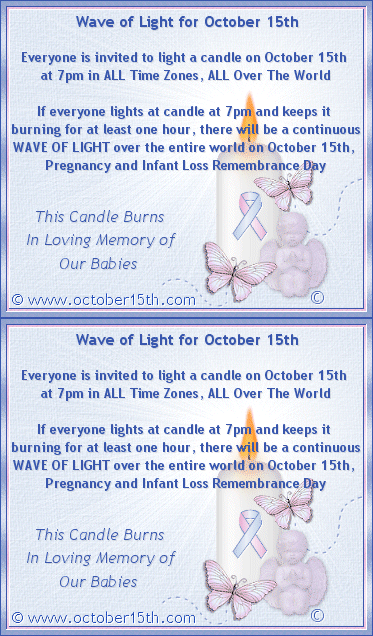
If you would like to honor the day, here is the information for the Wave of Light:


Please visit www.october15th.com to learn more about Pregnancy and Infant Loss Remembrance Day.

For all who have lost babies, born or unborn, my heart goes out to you and my thoughts are with you today. No one may know why your child could not be with you longer. All life is fragile, but it seems it is often even more so when it is brand new. As someone who has chosen to pursue a career in birth, I know this is something I have to live with, but I am still learning how.

Tuesday, October 12, 2010

Discovering and Celebrating Female Fertility

One commenter on my Progesterone post mentioned that she loved how Toni Weschler's book taught her that there is so much more to the female cycle than just menstruation. I also loved this about the book. I explained to my husband that I agreed with Weschler's assessment of our society's current ways of teaching women about our bodies. I know I looked at menstruation with fear and shame as a young girl. In fact, when I told my mother about my first menstural period, she congratulated me and told me it was wonderful. I thought that was awkward. It didn't feel wonderful to me because I was never taught what was so wonderful about it. I plan to have it be different for my daughter.

When one of my peers asked about it in the class about puberty at school, we were told that the non-blood secretions from the vagina were "bacterial discharge"--sounds nasty. How I wish we could have been taught by someone who knew the truth--that the white/clear stuff is actually a fluid produced by the cervix in response to normal hormonal changes during the cycle. Of course, going into specifics about how observing it for pregnancy achievement or birth control would not be appropriate for this age group, but now seeing the ignorance of those who were supposed to be teaching us about our bodies, I can't help but feel a bit betrayed.

For some great suggestions and links about celebrating your daughters becoming women, see The Menarche at Bellies and Babies.

I also wanted to share a few links for some great online resources about fertility charting:

The Beautiful Cervix Project
offers some cool pictures to supplement study of Fertility Awareness. It started with a woman using FAM for birth control sharing the photos she took of her cervix each day of her cycle, documenting the changes in it along with the other fertility signs she charted. The site has now expanded to include many different types of cervix pictures.

And here are a few sites that currently offer free charting software: